Hurtigruten unveils modern design for emission-free mail ship: Innovation boost on the way to climate-neutral shipping operations by 2030
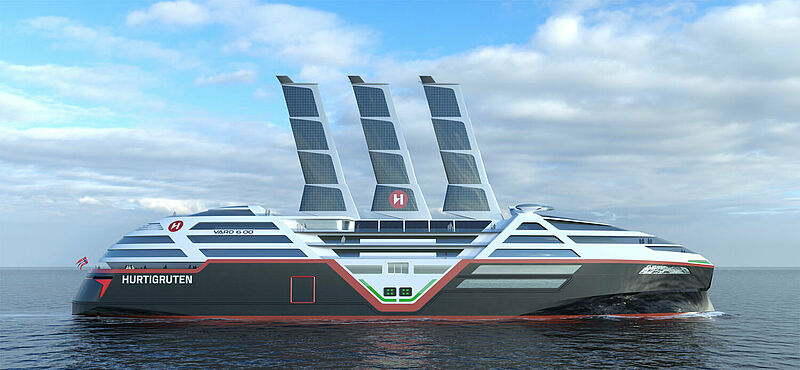
- Hedda Felin, CEO of Hurtigruten, emphasizes the importance of the project: “Shipping has contributed significantly to environmental pollution in the past. That is why we must now take measures to reduce emissions. Our goal is to operate an emission-free ship by 2030.” The ship design, developed by Vard in Ålesund in collaboration with the Norwegian shipping industry, represents an important milestone in the “Sea Zero” project.
- Energy saving through foldable sails and solar energy
- Technological innovations for emission-free ship operation
- Sustainable cabins for environmentally conscious passengers
- About the “Sea Zero” project
- About Hurtigruten
Hedda Felin, CEO of Hurtigruten, emphasizes the importance of the project: “Shipping has contributed significantly to environmental pollution in the past. That is why we must now take measures to reduce emissions. Our goal is to operate an emission-free ship by 2030.” The ship design, developed by Vard in Ålesund in collaboration with the Norwegian shipping industry, represents an important milestone in the “Sea Zero” project.
Energy saving through foldable sails and solar energy
A central element of the new design is foldable sails, which can be folded up when needed to pass low bridges easily. Initial calculations indicate that these sails could reduce energy consumption by around 10 %. In addition, solar panels could achieve further savings of 2-3%. The “OceanWings” sail type, which is already used on cargo ships, has been specially developed for this ship.
“The integration of solar panels into the sails opens up considerable savings potential. We are currently in the test phase and expect detailed results from our model simulations in the coming months,” explains Gerry Larsson-Fedde, COO of Hurtigruten.
Technological innovations for emission-free ship operation
Another innovative measure to save energy is the so-called air lubrication of the hull, in which air bubbles are pumped under the hull to reduce resistance in the water. This technology could reduce energy consumption by an additional 5-10%. Special tank tests are planned for early 2025 in Trondheim to further optimize the interaction between the hull and sails. A ship model will be exposed to different wave, current and wind conditions in a water basin in order to analyze its behavior and flow characteristics.
The planned ship will be equipped with counter-rotating propellers and batteries with a capacity of around 60 megawatt hours. Two retractable stern thrusters will ensure improved maneuverability and greater safety in port. In addition, improved ventilation and insulation systems as well as advanced energy management contribute to significant energy savings. “Our main goal is to reduce energy consumption, and to achieve this we are focusing on advanced solutions that go beyond the current standard,” emphasizes Larsson-Fedde.
Sustainable cabins for environmentally conscious passengers
Hurtigruten is introducing a test cabin of the so-called “Smart Cabins” on the MS Trollfjord. In these cabins, passengers can regulate their own energy consumption. Heating and ventilation can be controlled via an app and a display in the cabin, with the current energy consumption visible. “We are already testing advanced sensors in these cabins and plan to include guests in the tests soon,” says Larsson-Fedde.
With these steps, the “Sea Zero” project is making further progress. Hurtigruten is thus approaching its goal of having a sustainable, emission-free ship in operation along the Norwegian coast by 2030.
About the “Sea Zero” project
The “Sea Zero” project has set itself the goal of enabling emission-free passenger and freight transport along the Norwegian coast by 2030. To this end, Hurtigruten is developing emission-free mail ships and demonstrating their feasibility. The focus is on measures to increase energy efficiency (optimization of ship design and operation) and on energy supply (fuels and emissions). The port infrastructure is also to be adapted by expanding shore power connections. Some technologies are already mature, but need to be adapted for maritime use. Others still require basic research. The project is supported by industry partners, research institutions and developers from the relevant technology areas.
About Hurtigruten
Since 1893, Hurtigruten's mail ships have been operating scheduled services along the Norwegian coast, connecting 34 ports between Bergen and Kirkenes. The original Hurtigruten mail ship voyage is considered “the most beautiful sea voyage in the world”.
With the special Signature voyages, passengers can experience Norway and Spitsbergen from a new perspective. In summer, the MS Trollfjord offers a route to Spitsbergen from Bergen, while the winter North Cape route from Oslo connects the northernmost and southernmost points of the Norwegian coast. The hybrid ship MS Otto Sverdrup sails all year round from Hamburg along the fjord coast to the North Cape.