

Carnival Cruise Line Tests Classic Muster Drill in September 2026
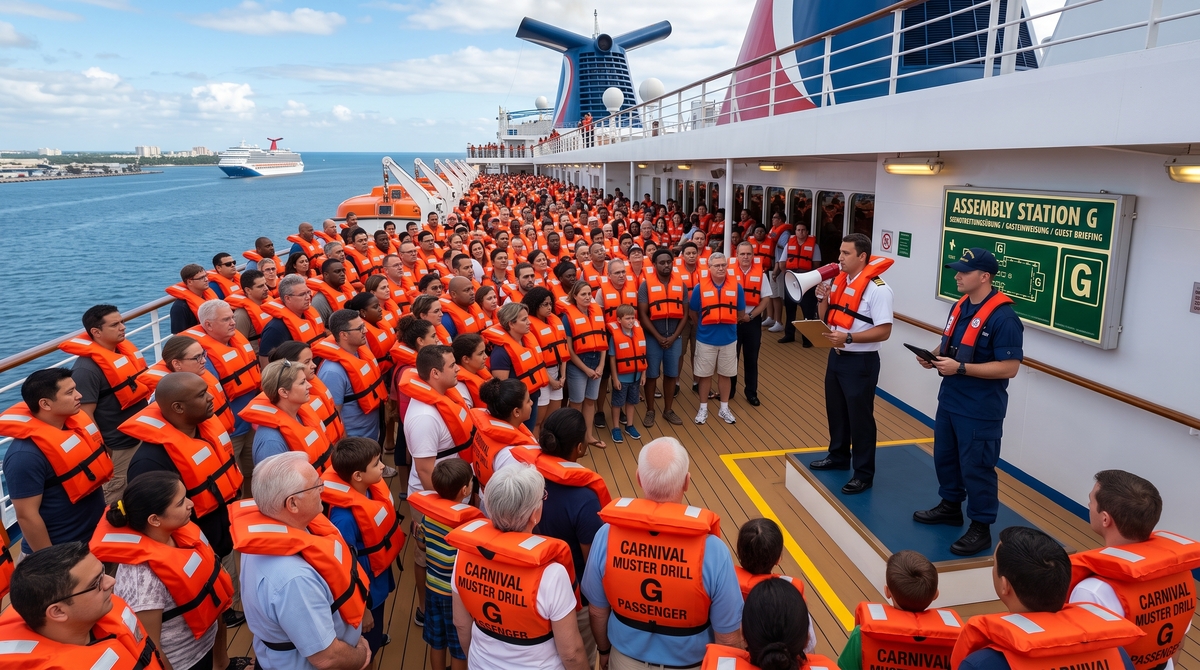
So why the sudden change of course? The reason lies in the strict safety regulations of the United States Coast Guard (USCG) and the international SOLAS guidelines. Roughly every six months, cruise ship crews must prove in real-world scenarios that they can safely coordinate large crowds under stress during an emergency. The modern E-Muster, where guests briefly check in at their station over a period of several hours, is simply not sufficient as a stress test for so-called crowd management. Therefore, authorities demand regular live drills, during which passengers act somewhat as extras. In emergency situations, this is particularly crucial to rehearse the safe evacuation of entire family groups and to test the crew's behavior under realistic conditions in congested stairwells or blocked escape routes.
For the passengers on the affected departures, this means a noticeable interruption on embarkation day. Starting around 1:30 PM, they must head to their assembly stations without hand luggage, as suitcases and bags would pose deadly tripping hazards in real emergencies. The entire onboard operation – from the bars to the pools – is completely suspended until the last crew member has rehearsed the emergency procedures and the final guest has been registered. Because passengers frequently show up late or stay in their cabins, this procedure can easily stretch to 45 minutes. This highlights how massively such exercises impact a ship's complex logistics and tight schedule.
Despite these temporary restrictions, the E-Muster has firmly established itself in the industry. It is true that the decentralized system actually ties up enormous personnel resources on arrival day, since the stations must remain staffed for hours. However, guests value the convenience of the digital solution so much that a complete return to the traditional mass drill is no longer commercially viable. Consequently, the cruise industry is moving toward a hybrid model: the digital E-Muster remains the standard, while occasional, government-mandated compliance sailings ensure that high safety standards at sea exist not only on paper but also in actual practice.

