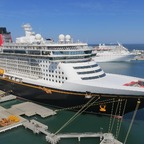
AIDAprima Route Change: Storm Forces Diversion to Copenhagen on Dec 2, 2025
-
etwas MEERzeit -
December 2, 2025 at 11:12 AM -
1,019 Views -
0 Replies

Verification of the Route Change The evaluation of ship movements confirms the cancellation of the Gothenburg call. Positioning data from the morning of December 2 show AIDAprima in the sea area between Skagerrak and Kattegat on a strict southerly course. The destination was updated in the AIS (Automatic Identification System) to "Copenhagen" with an arrival time of 13:00 CET. This aligns with data from the port operator Copenhagen Malmö Port, which now lists the ship at the Oceankaj terminal (Berth C332) earlier than planned. Simultaneously, the entry disappeared from the daily lists in Gothenburg.
Originally, after departing from Oslo, a stop in Gothenburg (08:00 to 18:00) was scheduled, followed by Copenhagen the next day. The new itinerary involves a direct transit to Denmark. The cancelled port day is compensated by a so-called "overnight stay" in the Danish capital, extending the docking time to over 26 hours.
Meteorological Background and Wind Load The decision to reroute is attributed to critical weather conditions. Low-pressure systems generated strong southerly winds in the Kattegat and on the Swedish west coast. Weather services such as DMI and SMHI forecast wind speeds of 27 knots with gusts up to 36 knots (approx. 8-9 Beaufort).
For a Hyperion-class ship like AIDAprima, these values are significant. With a length of 300 meters and a height of around 50 meters, the broadside offers a windage area of up to 15,000 square meters. Since wind force increases with the square of the speed, enormous forces act on the hull under these conditions. The approach to Gothenburg would have been particularly critical: With a course change towards the east, the strong southerly wind would have pressed massively against the starboard side (right). This would have required an extreme crab angle and maximum performance from the side thrusters to keep the ship in the fairway.
Nautic Challenges in Detail The port of Gothenburg poses specific risks during high winds:
- Archipelago Passage: The approach is narrow. High seas (approx. 2.5 meters) and wind drift make precise navigation difficult.
- Turning Maneuvers: To reach the quay, the ship often has to turn or stop. At this moment, the stabilizing forward momentum is lost, making the ship vulnerable to wind gusts.
- Safety Limits: The forecast gusts were significantly above the usual safety limits for a docking maneuver without extensive tug assistance.
Despite modern Azipod propulsion and bow thrusters, physics has limits. If the force required to countersteer demands almost the entire capacity of the engines, a maneuver must not be attempted for safety reasons.
Operative Execution and Logistics The decision was likely made in the night leading up to December 2, as no improvement in the weather was in sight. AIDAprima subsequently increased its speed to approx. 17 knots to reach Copenhagen by midday. Managing the logistics is complex:
- Port Slots: The fact that a berth was available in Copenhagen at short notice suggests good relationships with the port and lower utilization in winter.
- Supplies: Service providers for pilots, linesmen, and waste disposal had to be rescheduled within hours.
- Passengers: The shore excursions team on board had to cancel thousands of tickets for Gothenburg and organize a new program for the afternoon and evening in Copenhagen at short notice.
Economic and Tourist Implications For the cruise line, the swap means saved port fees in Sweden, but higher fuel costs for the faster journey and double docking fees in Denmark. Gothenburg loses estimated revenues in the six-figure range due to the cancellation, particularly affecting the local Christmas market. Copenhagen, on the other hand, benefits from unexpected purchasing power on a Tuesday evening.
From the passengers' perspective, safety is prioritized. The disappointment over the missed port is often mitigated by the exclusive experience of an overnight stay in Copenhagen.
Conclusion The rerouting of AIDAprima is an example of professional seamanship. In view of wind forces that made safe maneuvering on the port or starboard side impossible, safety was placed above the schedule. The operative solution maximizes the benefit for the guests through an extended time in Copenhagen.